



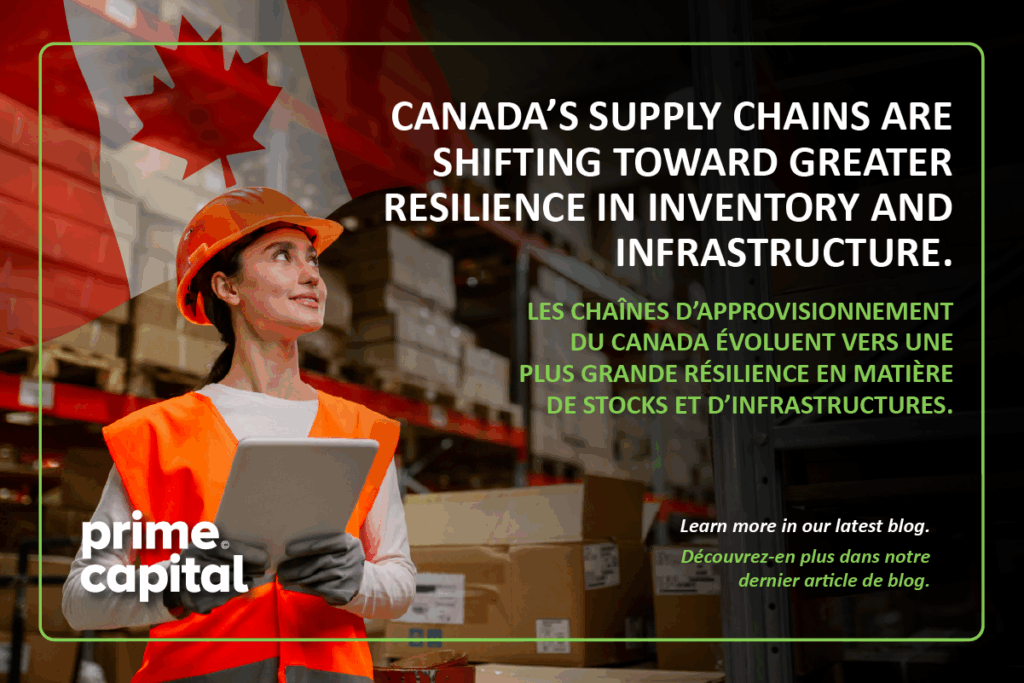
From “Just in Time” to “Just in Case”
Over the last few years, Canadian businesses have been stress testing their supply chains in real time.
Port disruptions, transportation delays, labour actions, and global uncertainty have exposed the limits of ultra-lean “Just in Time” inventory strategies. What used to look efficient on paper has, in many cases, translated into stockouts, missed orders, and strained customer relationships.
In response, many distributors, retailers, manufacturers, and logistics providers are shifting to a more resilient model. They are carrying more safety stock, using additional ports and routes, and building regional warehousing closer to customers. Industry reports indicate that many Canadian businesses are now holding more inventory than they did before 2020 as they adapt to a more volatile environment.
This pivot improves reliability. It also creates a new challenge.
Resilience requires physical infrastructure:
- Additional warehouse space
- More racking and storage systems
- Forklifts, reach trucks, and material handling equipment
- Yard tractors and local delivery vehicles
- Scanning, labelling, and warehouse management technology
Each of these assets demands capital. For many operations leaders and CFOs, the question is no longer whether to invest in resilience. It is how to build it without locking up working capital or overextending existing credit lines.
This is where a structured approach to financing becomes part of the supply chain strategy, not an afterthought.
How Prime Capital helps turn supply chain pressure into a financing strategy
Prime Capital works with warehouse operators, third-party logistics providers, distributors, and growing retailers that are rethinking their physical networks for the next decade.
Instead of treating racking, forklifts, and secondary fleets as isolated purchases, we help teams design leasing strategies that support reliability, cash flow, and growth. With the right structure, leasing can help companies turn supply chain pressure into a manageable, strategic plan.
Build new storage capacity without freezing capital
Creating resilience often starts with storage. New or expanded facilities need pallet racking, mezzanines, conveyors, dock equipment, safety barriers, and appropriate lighting long before the first pallet arrives.
Purchasing everything upfront can drain the capital needed for inventory, staffing, and systems. Leasing allows businesses to spread these costs over time so they can open or expand facilities sooner, keep cash available for stock and operations, and treat storage infrastructure as a planned, predictable expense instead of a one-time financial shock.
Equip warehouses for higher throughput
More inventory and more locations mean more movement inside the four walls. Forklifts, reach trucks, order pickers, and other handling equipment often need to scale with volume, and safety and productivity standards are rising at the same time.
Leasing gives operations teams the flexibility to add equipment as volumes grow, upgrade to more efficient units without waiting for full depreciation, and standardize fleets across locations for easier training and maintenance. Instead of stretching older machines past their optimal life, operators can plan regular refresh cycles that match workload and staffing.
Expand local and regional fleet capacity
Resilient supply chains depend on reliable movement between sites and to end customers. Regional and last-mile fleets may include straight trucks, sprinter-style vans, and yard trucks that shuttle trailers from dock to dock.
Leasing allows businesses to grow this capacity in step with demand rather than making large one-time purchases that strain cash flow. Terms can be structured around seasonal peaks, new customer contracts, or changes in service territory so that capital remains available for fuel, wages, and maintenance.
Integrate technology into a broader equipment plan
Modern warehouses depend on technology as much as physical equipment. Scanners, label printers, scales, and in some cases, warehouse management or automation systems are integral to accuracy and speed.
Where appropriate, these elements can be included in a broader financing approach so that new facilities open with both equipment and technology in place, upgrades to scanning or labelling can be coordinated with equipment refreshes, and costs are easier to allocate across sites and customer accounts.
Prime Capital’s role is to help operators see the full picture and design leasing plans that fit the way their network operates, not just the next asset they need to buy.
A common situation for distributors and logistics providers
A situation that often arises for operators is a mid-sized distributor that built its business around a central warehouse and lean inventory.
In recent years, the company has faced longer lead times from overseas suppliers, greater transportation volatility, and growing frustration from customers when stock is unavailable. Leadership decides to open a new regional warehouse closer to key customers and carry more safety stock on core items. Operationally, it is the right decision. Financially, the list is long.
The new site requires racking, lift equipment, dock work, yard and local delivery vehicles, scanning and labelling tools, and additional staff and training. Purchasing all of this upfront would use a significant portion of the company’s available capital and put pressure on existing credit facilities at a time when flexibility is crucial.
In a situation like this, a leasing strategy can change the conversation.
Instead of delaying the project or cutting corners, the distributor can lease racking, forklifts, and dock equipment over terms that match expected throughput, finance regional delivery vehicles based on realistic volume projections, and preserve cash for inventory, staffing, and customer onboarding.
The result is not simply a new building with shelves. It is a more resilient network that can support customer growth and withstand future disruptions, backed by a financial structure that respects the company’s risk tolerance.
Industry insight: why financing is now part of supply chain design
Supply chain discussions used to focus almost exclusively on process and software. Today, physical infrastructure and financial structures are an equal part of the conversation.
As businesses move from “Just in Time” to more resilient models, three realities are emerging.
Resilience is capital-intensive
Holding more inventory, operating more sites, and diversifying routes all require investment. Businesses that recognize this and plan their financing strategy accordingly are better positioned than those that treat it as a series of one-off purchases.
Leasing helps companies match asset life with financing terms, avoid tying up lines of credit meant for working capital, and spread investments over time rather than concentrating them in a single budget year.
Physical infrastructure is part of the customer value proposition
Service levels, delivery reliability, and responsiveness are becoming key differentiators. Customers notice when lead times shrink, stockouts decrease, and communication improves.
Behind the scenes, this performance often depends on additional storage in key regions, redundant lanes and carriers, and modern handling equipment that supports higher throughput. Financing helps businesses put this infrastructure in place without sacrificing the financial stability that customers also expect from their partners.
Flexibility is as important as cost
Total cost still matters, but flexibility is now a central part of supply chain strategy. Businesses need the ability to scale up, adjust footprints, or repurpose assets as demand changes.
Leasing supports this by making it easier to adjust capacity over time, providing structured terms rather than permanent balance sheet burdens, and allowing planned refreshes as operations evolve.
Prime Capital’s experience with logistics and distribution clients helps companies build this flexibility into their equipment plans from the start, so finance and operations can move in step instead of negotiating around every major purchase.
What success can look like for warehouses and logistics teams
When supply chain and finance leaders work together, backed by a thoughtful leasing strategy, several positive outcomes become possible:
- More reliable service for customers, supported by adequate stock and capacity
- Improved delivery performance through better-equipped regional and last-mile operations
- More predictable cash flow with known monthly obligations rather than large, irregular capital spikes
- Greater agility to add or adjust facilities and fleets as markets and customer requirements change
Most importantly, the physical network becomes a genuine asset to the business rather than a constant constraint.
Prime Capital’s role is to help teams design financing approaches that support the supply chain they want to build, not just the next purchase order.
Build your next supply chain upgrade with confidence
If your business is expanding warehousing, adding material handling equipment, or increasing regional delivery capacity, the way you finance those decisions will shape your flexibility for years to come.
Leasing can help you stand up new facilities with the right equipment from day one, protect cash flow while inventory and operations scale up, and keep your options open as customer needs and market conditions evolve.
If you are planning your next phase of supply chain investment, talk to Prime Capital about leasing options for warehousing equipment and regional fleets so you can build resilience without sacrificing financial stability.